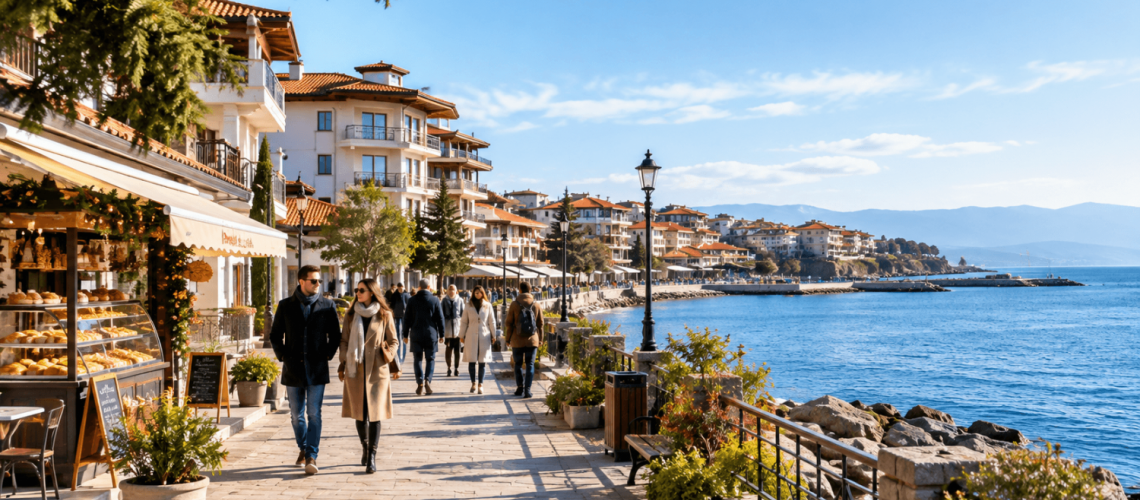
The Bulgarian coast is traditionally perceived exclusively as a summer holiday location. From October, the tourist flow drops, seasonal restaurants, water parks, and souvenir shops close. However, life by the sea does not stop. Thousands of foreigners and locals stay to winter in the coastal zone, and for a comfortable stay in the off-season, you just need to choose the right area and building.
The secret of a successful wintering lies in understanding the difference between purely tourist clusters and fully-fledged settlements. If you plan to buy property near the sea for year-round living, avoid remote gated complexes standing on the periphery. In winter, there will be no working shops or regular transport connections.
Cities with developed year-round infrastructure are Burgas, Varna, Pomorie, and Sveti Vlas. Pomorie, thanks to its balneological sanatoriums, remains active all year round. Supermarkets, clinics, banks, and schools operate here. Sveti Vlas, built with an eye on permanent residence, also does not empty out. The local administration keeps the streets clean, and cafes, bakeries, and pharmacies are always open in the center.
The situation with Sunny Beach is more complicated. The outskirts of the resort die out until May. But the central part, especially the areas near the year-round supermarkets "Mladost" and "Janet", continues to function. Many apartment owners stay there for the winter, and the bus station operates normally. The neighboring Nessebar, specifically its new part, lives in a normal city rhythm regardless of the season. Another good location is Ravda. The village merges smoothly with Nessebar and has a measured rhythm; a school, a kindergarten, and convenience stores are open here in winter.
The technical nuances of winter living depend directly on the type of construction. Bulgarian winters are mild, but due to high humidity and strong winds from the sea, it can be chilly at zero degrees. There is no central heating on the coast. Apartments are heated by air conditioners, infrared panels, underfloor heating, or pellet stoves. The quality of the building's thermal insulation comes to the fore.
Buyers often consider options from a developer, as modern construction standards in Bulgaria require the use of high-quality insulation and energy-efficient double-glazed windows. New buildings retain heat much better, which significantly reduces electricity bills in January and February.
On the other hand, resale property is located in already settled areas without noisy construction work. You can immediately see the condition of the complex, the quality of the management company's work, and talk to neighbors to find out how warm the apartments are in winter. In resale properties, inverter air conditioners are often already installed, and modifications for permanent residence have been made.
A crucial factor when buying is electricity tariffs. Bulgaria has a dual-tariff accounting system (day and night tariffs). In winter, when the entire load falls on electric heaters and boilers, the night tariff helps to save money. It is necessary to make sure that the complex is commissioned (has Act 16) and has separate personal electricity accounts for each owner (household current). Some apart-hotels pay a single industrial tariff, which is significantly more expensive.
When choosing an apartment, specify the size of the maintenance fee. In year-round complexes, this money goes towards security, territory lighting, elevator operation, and keeping common areas in order when most owners have left. The specialists of the Bulgarian Resales agency, which specializes in liquid properties on the Black Sea coast, will help you check the documents, ensure the presence of household current, and select a location with winter infrastructure.